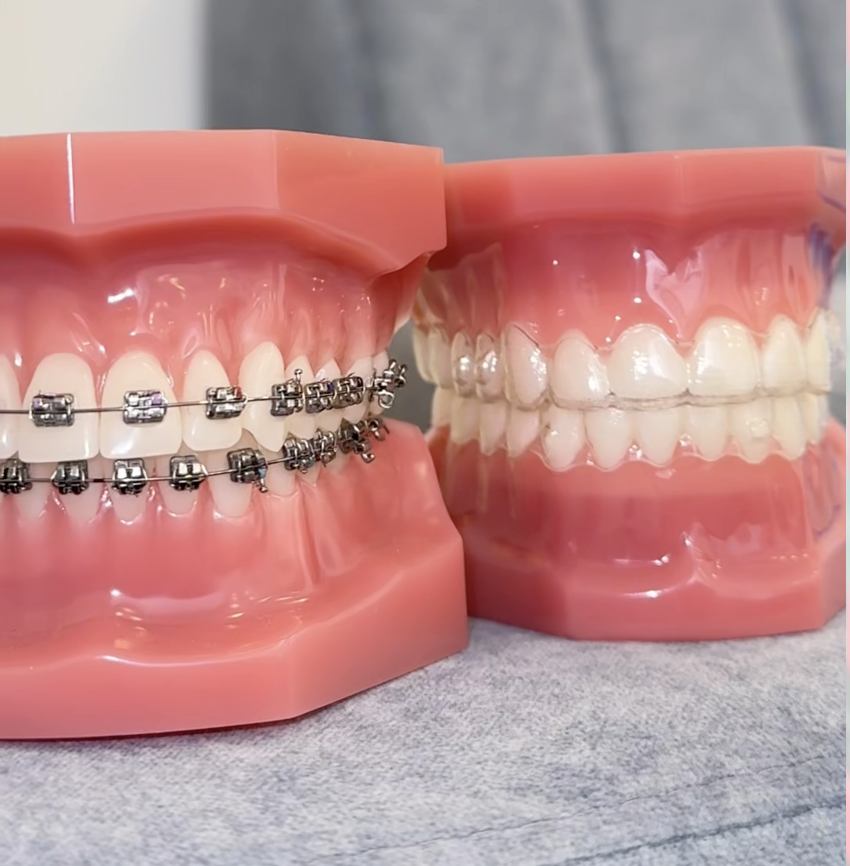
Braces vs. Aligners — Which One Is Right for You?
Hello! I'm Dr. Watt Sook May, a dentist with orthodontic training. I completed my Bachelor of Dental Surgery and Master of Dental Surgery in Orthodontics at the National University of Singapore, and I spend a lot of my time in clinic answering questions that patients have been quietly Googling before their appointment.
These blog posts are my attempt to answer those questions properly — with actual evidence behind them, but without the jargon. My goal is simple: to give you clear, honest, research-backed information so you can walk into your consultation already understanding the basics, and leave feeling confident about your treatment plan. Orthodontic treatment is a significant commitment of time and investment — you deserve to understand exactly what you're signing up for.
Braces vs. Aligners — Which One Is Right for You?
If you've ever sat in the consultation chair wondering "braces or aligners?", you're definitely not alone. It's one of the most common questions I get asked, and honestly, there's no one-size-fits-all answer. Both work — but they work differently, and the best choice depends on your specific teeth, lifestyle, and how committed you are to the process.
Here's what the research actually says.
They both move teeth the same way — biologically
Let's start with the good news: both braces and aligners move your teeth through the exact same biological process. Your bone breaks down on one side and rebuilds on the other, allowing teeth to shift gradually into their new positions. The appliance is just the vehicle delivering the force — the biology is identical.
For complex cases, braces have the edge
Where they differ is in precision. A large body of research, including a comprehensive systematic review by Yassir et al. (2022), consistently shows that traditional braces produce more predictable results in complex cases. This is because brackets and wires give dentists very fine control over root position — not just where the crown (the visible part of your tooth) ends up, but where the root goes too. That level of 3D control matters a lot when correcting significant bite problems.
Clear aligners, on the other hand, are excellent at "tipping" teeth — think of it like nudging individual teeth at an angle. For mild to moderate crowding and spacing, they perform just as well. But for cases that need serious root movement or bite correction, the research suggests braces tend to be more reliable (Ke et al., 2019).
Aligners only works if you actually wear it
Here's the honest truth about aligners that I always tell my patients upfront: the results are entirely in your hands. When aligners aren't worn for the recommended 20–22 hours a day, teeth simply don't move as planned. The digital plan is precise — but it assumes the trays are in your mouth, not on your bedside table.
Braces, by contrast, work around the clock because they're fixed. You don't have to remember anything. For patients who know they'll struggle with the discipline of wearing aligners consistently, braces are often the more predictable choice.
Flexibility for busy schedules and frequent travellers
One practical advantage of clear aligners that often gets overlooked is how they fit into a less predictable lifestyle. Traditional braces typically require regular in-person adjustment appointments — usually every 4 to 8 weeks — where we changes the wires and monitors progress. If you frequently travel for work, live between two countries, or simply have a schedule that makes consistent clinic visits difficult, missing or delaying these appointments can slow down your treatment significantly.
Clear aligners offer more flexibility here: your trays are pre-programmed in advance, and you progress through them on a set schedule at home. As long as you are wearing them as prescribed and attending periodic review appointments, short periods away from Singapore are much less disruptive to your treatment timeline. That said, regular check-ins with your dentist are still important — aligners are not a fully unsupervised process — but the visits tend to be less frequent and more flexible to schedule.
A note on aesthetics — it's not quite as simple as "invisible vs. visible"
Clear aligners are often marketed as invisible, and while they are certainly far more discreet than braces, the full picture is a little more nuanced. Most aligner treatments require small tooth-coloured bumps called attachments to be bonded onto your teeth — these give the aligner something to grip, which is how more complex movements are achieved. Some cases also require buttons, small brackets bonded onto specific teeth to anchor elastics
Elastics — small rubber bands worn between the upper and lower teeth — are used to help correct the relationship between your upper and lower jaw, and are a routine part of many orthodontic treatments regardless of the appliance. While attachments are tooth-coloured and aligners are clear, they are visible up close, particularly on your front teeth. So "nearly invisible" is a more accurate description than "invisible."
On the braces side, aesthetics have also come a long way. While traditional metal brackets remain the most widely used option — they are durable, reliable, and cost-effective — patients who are concerned about appearance can opt for ceramic (tooth-coloured) brackets instead. These blend in considerably better with the natural tooth colour. The trade-off is that the archwire running through the brackets — the wire that actually does the heavy lifting of moving your teeth — is typically still metal, for durability and predictability. So ceramic braces are more aesthetic than metal braces, but the wire will still be visible. Elastics may also be required with braces, for the same bite-correction reasons as with aligners.
Comfort and oral hygiene
Both braces and aligners involve some adjustment discomfort when you first start on treatment as your teeth begin to move.
Oral hygiene is generally easier with aligners simply because you take them out to brush and floss normally. But maintaining good oral hygiene with braces is not impossible too, as long as you know which specific tools.
So which is right for you?
Choosing between braces and aligners is rarely a straightforward decision, and the right answer looks different for every patient.
Braces — whether metal or ceramic — tend to be the more predictable choice for complex cases requiring precise root control, and they remove the burden of daily compliance entirely.
Clear aligners shine for mild-to-moderate cases, patients who prioritise discretion and need more flexibility between appointments.
On the aesthetics front, neither option is without compromise — aligners come with attachments and sometimes elastics that make them less invisible than advertised, while ceramic braces offer a more discreet alternative to metal but retain a visible metal wire.
Hygiene-wise, aligners have the edge simply because they come out for brushing and flossing. But maintaining good hygiene is also possible with braces, as long as you have the right tools.
Ultimately, the best appliance is the one that suits your specific bite, your lifestyle, your compliance level, and your priorities — and that is exactly the conversation to have with your dentist at your consultation.
In summary
The right answer is always the one that suits your case complexity, your lifestyle, and your commitment level. That's exactly what your consultation is for.
References
Yassir et al. (2022). Effectiveness of clear aligners in comparison with fixed appliances: A systematic review and meta-analysis.https://pubmed.ncbi.nlm.nih.gov/34993617/
Ke et al. (2019). A comparison of treatment effectiveness between clear aligner and fixed appliance therapies.https://pubmed.ncbi.nlm.nih.gov/30674307/
Di Spirito et al. (2023). Periodontal health and clear aligner treatment: A systematic review and meta-analysis.https://pmc.ncbi.nlm.nih.gov/articles/PMC10178428/
Follow for bite-sized orthodontic education, patient resources and life as a dentist
drwattsookmay.com | IG: @drwattsookmay | TikTok | YouTube | Threads
Read more on the clinic blog here: https://www.tanglindental.com/blog/invisalign-vs-braces
