Videos
Self-produced, unfiltered
Featured



Self-produced, unfiltered

To all dentists who do ortho — what’s the difference between these 2 transpalatal arches? 🤔

🦷 What’s the difference between these 2 transpalatal arches? 🤔 After my previous video, I could tell many of you were curious! 😄
In Part 1 of this series, I’m breaking down how a transpalatal arch made with traditional molar bands is fabricated 🛠️👩🏻⚕️
(And yes… the photo with separators is actually me 🤭 — I know they’re on the lower arch but you get the idea! Fun fact: we placed separators on each other during residency)
Stay tuned for Part 2 — the digital version! 💻✨ If you found this helpful, do give it a like or save — and let me know what else you’d like to see! 💬

🦷 What’s the difference between these 2 transpalatal arches? 🤔 After my previous video, I could tell many were curious about the answer! 😄
In Part 2 of this series, I explain what digitally printed bands are and the differences with traditional molar bands. If you found this helpful, do give it a like or save — and let me know if you’d like to see more content like this! 💬

Understanding facial growth is a fundamental part of orthodontic treatment planning.
Timing and growth assessment matters.
Growth doesn’t occur in just one direction — in orthodontics, we assess growth in three dimensions. Discrepancies across these planes often coexist and influence treatment decisions.
Disclaimer: This content is for educational purposes only and is not intended to replace a consultation with your dentist. This graphic is non-exhaustive and has been intentionally simplified for ease of understanding.

I was bonding the other day and realized how different my approach is now compared to when I first started placing fixed appliances during residency.
Not that what I do now is perfect — but experience definitely changes the little details of how you work. Always learning… maybe I should revisit this again in a few years and see how it changes. 😄
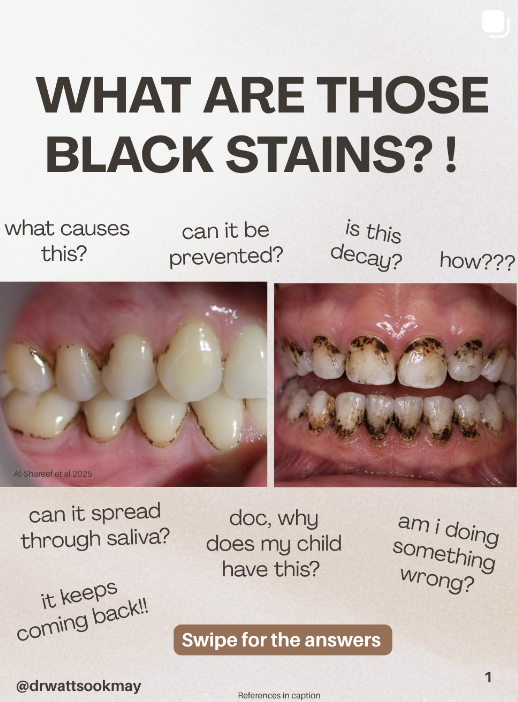
What exactly are those stubborn black stains on your teeth? 🛑Before you panic — they’re not necessarily tooth decay!
Swipe through to learn:🦷 what these black stains actually are, 🔍 how they differ from other types of tooth stainsm ✨ how we remove them in the clinic, 🔄 and why it keeps coming back even after a cleaning.
This is NOT a replacement for a dental checkup, but there are 2 important reasons I’m sharing this
Taking your child to the dentist for the first time can feel daunting, especially if you’re not sure how they will react. Will they sit in the dental chair? Will they open their mouth? Will they cry?
As a Singapore dentist who sees children as part of my general dental practice, I’ve noticed that some 3- to 6-year-olds tend to settle into the dental environment more easily. While every child is different, there are a few things these children often have in common.
Have parents or grandparents with a toothache or a loose tooth who are thinking about having it extracted? 🦷
Before their appointment, here are 3 important things they should know.