Retainer wear & care instructions
Congratulations on completing your orthodontic treatment — your smile looks amazing! But the journey doesn't quite end here. Retainers are one of the most important parts of your orthodontic treatment, and wearing them consistently is what keeps your results looking great for life. Here's everything you need to know.
Why do I need a retainer?
After orthodontic treatment, your teeth have a natural tendency to drift back towards their original positions — a process called relapse. This happens because the bone and gum fibres surrounding your teeth need time to fully stabilise in their new positions, and even after they do, the forces of biting, chewing, and everyday use continue to exert pressure on your teeth throughout your life.
Retainers hold your teeth in their corrected positions while this stabilisation happens — and beyond. Think of your retainer as the guardian of your smile. The treatment moved your teeth. The retainer keeps them there.
Types of retainers
Removable retainers
Essix retainer — a clear, thin plastic retainer that fits over your teeth like an aligner. Virtually invisible and comfortable to wear
Hawley retainer — a traditional retainer with a plastic base and metal wire across the front teeth. More durable and adjustable than clear retainers
Fixed retainers
A thin wire bonded to the inner surface of your front teeth — usually the lower front teeth
You cannot remove this yourself — it stays in place permanently unless removed by your dentist
Requires careful cleaning around the wire with floss threaders or interdental brushes
Your dentist will recommend the most appropriate type — or combination of types — based on your individual treatment and needs.
How long do I need to wear my retainer?
For as long as you would like your teeth to be straight!
For the first 6 months to 1 year after treatment, wear your retainer full time — removing it only for eating, drinking anything other than plain water, and brushing
After this initial period, your dentist will advise transitioning to nightly wear — every night, indefinitely
Retention is a lifelong commitment — teeth never fully stop moving throughout life. Wearing your retainer nightly long-term is the only way to protect your investment in your smile
The most common reason teeth shift after orthodontic treatment is inconsistent retainer wear — please don't let this be you! 😊
If you have switched to night time wear but your retainers still feel tight whenever you wear them at night, it could be a sign that you have switched to night time wear too soon.
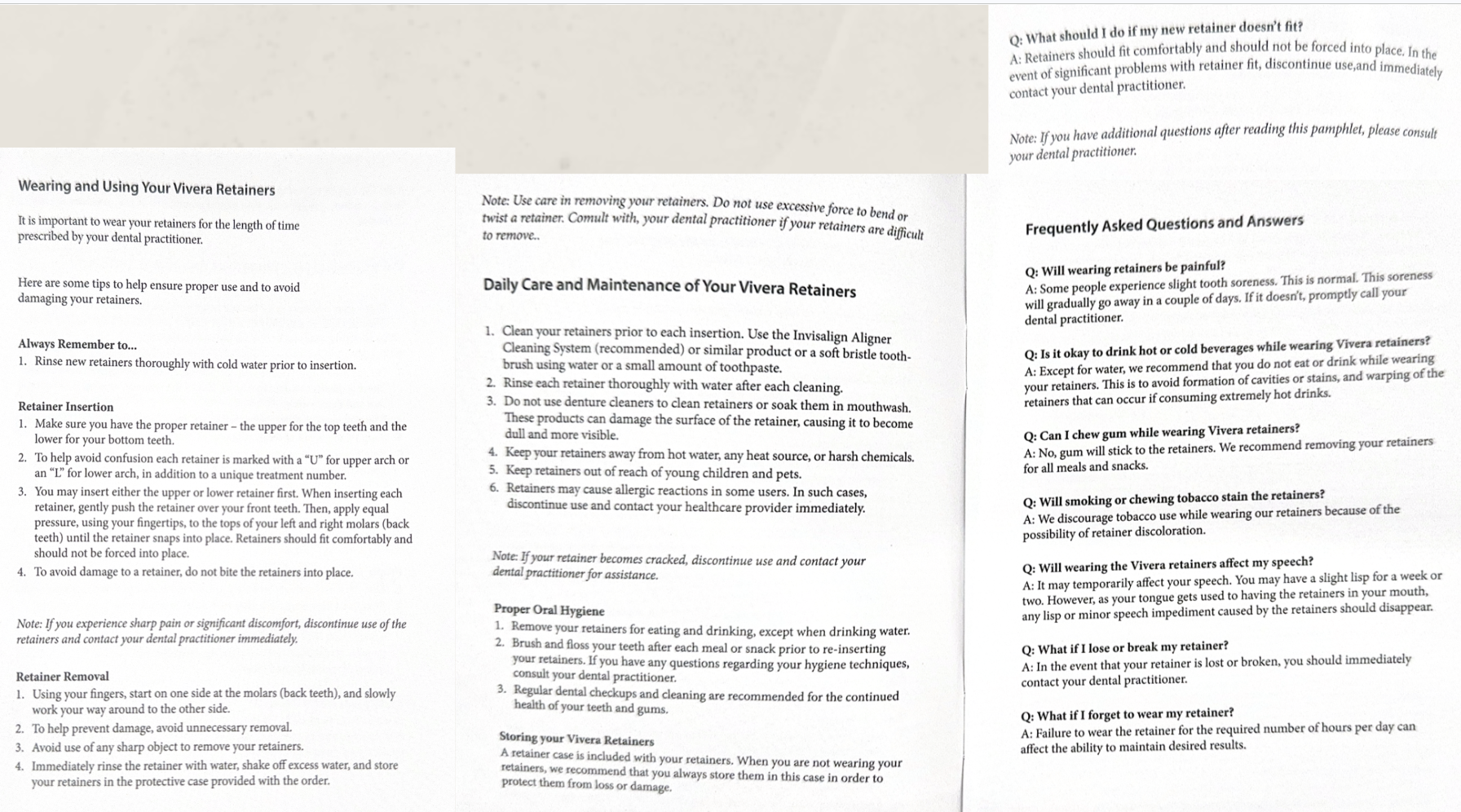
Wearing your removable retainer
Always insert and remove your retainer with clean hands
Insert gently using your fingers
Remove from both sides evenly to avoid distorting the fit
Never leave your retainer out for extended periods — even a few days without wearing it can cause your teeth to shift, making the retainer feel tight or difficult to re-seat
If your retainer feels tight when you put it back in — this is a sign your teeth have moved. Wear it consistently and contact your dentist if it does not re-seat comfortably
It is advisable to remove your retainers when eating and brushing.
Feel free to drink plain water while wearing your retainers!
Cleaning your removable retainer
Rinse your retainer with cold water every time you remove it
Clean it at least once a day using a soft toothbrush and clear unscented soap — toothpaste is too abrasive and will scratch the surface, causing it to become cloudy over time
Use retainer cleaning tablets for a deeper clean — soak as directed on the packaging
Never use hot water — it will warp the plastic and ruin the fit
Never soak in mouthwash — most mouthwashes contain pigments that will stain your retainer
Clean the retainer case regularly too — bacteria can accumulate inside
Be careful not to squeeze the retainers too tight while cleaning as the retainers may break at its weakest point.
Optional: you may purchase a ultrasonic retainer cleaner for cleaning at home!
Caring for your fixed retainer
Brush carefully along the wire and around the bonded points twice daily — use a soft toothbrush at a 45-degree angle
Use a floss threader or superfloss to floss between teeth with the fixed retainer in place — regular floss cannot pass under the wire without a threader
A water flosser is highly recommended for fixed retainer patients — it makes cleaning around the wire significantly easier
Use an interdental brush to clean around the wire where the toothbrush cannot reach
Avoid biting directly into very hard foods that could dislodge or bend the wire
If the wire feels loose, has detached from a tooth, or is poking your tongue — contact your dentist promptly. Do not leave a loose fixed retainer unattended as the affected tooth may begin to shift. If you have an overlying removable retainer, continue to wear that in the mean time.
Storing your retainer
Always store your retainer in its case when not in your mouth — never wrap it in tissue, leave it on a food tray, or place it loose in a bag
Be careful not to wrap it in tissue! - this is the most common reason why patients lose their retainers
Keep your retainer case somewhere visible and consistent — the bathroom counter, your bedside table, or your bag
Keep away from pets
Keep away from heat — do not leave your retainer in a hot car, near a stove, or in direct sunlight
What to do if your retainer is lost, broken, or no longer fits
This is urgent. Contact your dentist as soon as possible — the longer you go without a retainer, the more your teeth may shift
Do not attempt to adjust, bend, or repair a broken retainer yourself
If your retainer no longer fits due to a period of inconsistent wear — do not force it. Contact your dentist who will assess whether your retainer can be reused or whether a new one is needed
In some cases, a short course of additional orthodontic treatment may be needed to correct shifting that has occurred — this is why consistent wear is so important
💡 Dr Watt's tip: The number one thing I hear from patients who need retreatment is "I stopped wearing my retainer." Please don't let that be you — your retainer takes 30 seconds to put in before bed. That's all it takes to protect months or years of orthodontic treatment. Your future self will thank you! 😊
When should I bring my retainers?
Don’t forget to bring along your retainers during your retainer review appointment
Bring along your retainers whenever you have a dental appointment! (even when you are not seeing your braces dentist). This is because if you require fillings, the dentist will have to check the fit of your retainer after the filling is done.
Can I make a spare set of retainers?
Of course! Please let your dentist know.