Oral hygiene & patient guide after orthognathic surgery
Orthognathic surgery — commonly known as jaw surgery — is a significant procedure, and how well you care for yourself in the recovery period plays a huge role in how smoothly and comfortably you heal. This guide covers everything you need to know about oral hygiene, eating, recovery, and what to expect in the days, weeks, and months after your surgery.
What is orthognathic surgery?
Orthognathic surgery is a surgical procedure performed to correct significant discrepancies in the position of the upper jaw, lower jaw, or both. It is carried out by an oral and maxillofacial surgeon, usually in close collaboration with your dentist, and is typically performed under general anaesthesia in a hospital setting.
Common procedures include:
Le Fort I osteotomy — repositioning of the upper jaw
Bilateral sagittal split osteotomy (BSSO) — repositioning of the lower jaw
Genioplasty — repositioning of the chin
Bimaxillary osteotomy — simultaneous repositioning of both jaws
The goal of orthognathic surgery is to correct the relationship between the jaws to improve function — including biting, chewing, speaking, and breathing — as well as facial balance and aesthetics.
Immediately after surgery — the first 24 hours
You will wake up from surgery with swelling, numbness, and discomfort — this is completely expected and normal
Your mouth may be held in position with elastics or wires — do not attempt to remove these yourself
Bleeding and oozing from the surgical sites in the first few hours is normal — your surgical team will manage this before you are discharged
You will be given pain relief and anti-inflammatory medication — take these as prescribed and do not wait until pain is severe before taking them
A soft or liquid diet will begin immediately — your surgical team will advise you on what is appropriate in the first days
Do not blow your nose for the first 2 weeks if upper jaw surgery has been performed — this can introduce air and bacteria into the surgical site. If you need to sneeze, sneeze with your mouth open
Rest as much as possible — your body is doing an enormous amount of healing
Managing swelling
Swelling is one of the most significant aspects of orthognathic surgery recovery — and it is important to understand the timeline so you are not alarmed:
Swelling peaks at approximately 48–72 hours after surgery before gradually improving
Significant swelling of the face, lips, and cheeks is completely normal and expected — some patients find the degree of swelling surprising. This is normal
Apply ice packs to the face for 10 minutes on, 10 minutes off during the first 24–48 hours to help manage swelling
After 48 hours switch to warm compresses to help the swelling continue to resolve
Sleep with your head elevated on two or more pillows for the first 1–2 weeks to reduce swelling
Most visible swelling resolves over 4–6 weeks — however residual swelling can persist for several months. The final result is not fully visible until swelling has completely resolved which can take up to 12 months
Oral hygiene after orthognathic surgery
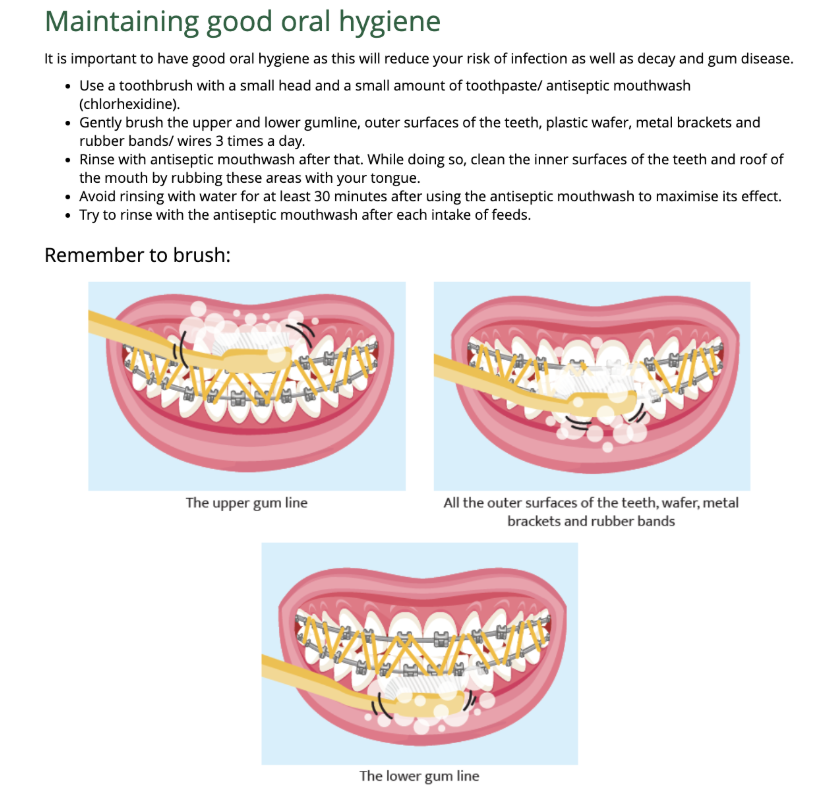
https://www.sgh.com.sg/patient-care/specialties-services/oral-and-maxillofacial-surgery/pages/post-operative-care-for-orthognathic-surgery.aspx
Keeping your mouth clean after jaw surgery is absolutely critical — but it requires a very gentle approach, especially in the early stages. The surgical sites are delicate and must not be disrupted.
Week 1
Do not brush your teeth for the first 24–48 hours after surgery
From day 2–3, begin gently rinsing your mouth with the chlorhexidine mouthwash prescribed by your surgeon — swish very gently and allow it to drain out without spitting forcefully
Warm salt water rinses — gently swish after every meal from day 2 onwards. Use half a teaspoon of salt dissolved in a warm glass of water. Allow it to gently flow around the mouth and drain out — do not rinse vigorously
Use a small, extra-soft toothbrush — a baby toothbrush is ideal in the first week — to very gently clean the surfaces of your teeth. Avoid the surgical sites entirely in the first week
Clean the areas you can access — the biting surfaces and outer surfaces of the teeth away from the surgical sites
Do not use an electric toothbrush in the first 2 weeks — the vibration can disturb the surgical sites
Week 2
Continue with gentle warm salt water rinses after every meal
Continue with chlorhexidine mouthwash as prescribed
Begin to gradually extend the area you brush — still using an extra-soft toothbrush with very light pressure
Avoid direct brushing over suture lines and surgical sites — brush around them gently
Week 3 onwards
Gradually transition back to your normal toothbrush — continue using extra-soft bristles
Extend brushing to cover all tooth surfaces as comfort allows
Continue warm salt water rinses after meals
Introduce flossing very gently once your surgeon confirms healing is progressing well
If you have braces, resume normal orthodontic oral hygiene as directed — interdental brushes, floss threaders, and water flosser
Diet and eating after orthognathic surgery
Your diet will progress through stages as your jaw heals — patience here is key.
Week 1–2 — Full liquid diet
Everything must be in liquid form — no chewing whatsoever
Suitable foods: smoothies, protein shakes, blended soups, milk, yoghurt drinks, juice, meal replacement drinks
Ensure adequate protein and caloric intake — healing requires significant nutritional resources and it is common to feel hungry in the first few weeks. A blender will become your best friend!
Avoid very hot liquids — sensitivity and numbness means you may not feel heat accurately and could burn yourself
Drink through a cup or spoon — avoid straws in the first 2 weeks as the suction can disturb blood clots and healing tissue
Stay well hydrated — drink plenty of water throughout the day
Week 3–6 — Soft food diet
Progress to soft foods that require minimal chewing — mashed potato, soft tofu, scrambled eggs, soft fish, congee, well-cooked pasta, and soft fruits
Avoid anything that requires significant biting force
Cut all foods into very small pieces
Chew gently and evenly on both sides
Week 6 onwards — Gradual return to normal diet
Your surgeon will advise when you can begin to gradually introduce firmer foods
Progress slowly — do not rush back to hard or chewy foods
Avoid very hard foods such as nuts, raw carrots, hard candy, and crusty bread until fully cleared by your surgeon
Full return to a normal diet typically takes 3–6 months depending on the extent of surgery and healing
Numbness and altered sensation
Numbness of the lips, cheeks, chin, and gums after jaw surgery is extremely common — and for many patients, one of the most concerning aspects of recovery.
Numbness occurs because the nerves in the jaw are stretched, compressed, or repositioned during surgery — this is expected and anticipated
For most patients, sensation gradually returns over a period of weeks to months
In some cases, altered sensation such as tingling, pins and needles, or hypersensitivity may be experienced as the nerves recover — this is a positive sign that sensation is returning
Complete return of sensation can take up to 12–18 months in some patients
In rare cases, some degree of altered sensation may be permanent — your surgeon will discuss this risk with you before surgery
Be careful with hot food and drinks during the period of numbness — you may not be able to accurately sense heat and could burn yourself
Jaw exercises and physiotherapy
Your surgeon or braces dentist may recommend specific jaw opening exercises after surgery — follow these precisely as they help prevent stiffness and scar tissue formation
Limited mouth opening is common in the early weeks — do not force the jaw open
Gentle jaw exercises as directed help to gradually restore full range of motion
Some patients benefit from formal physiotherapy for the jaw — ask your surgeon if this is appropriate for your recovery
Medications
Take all prescribed medications as directed — including pain relief, anti-inflammatories, and antibiotics if prescribed
Complete the full course of any antibiotics — do not stop early
Do not take aspirin or aspirin-containing products unless specifically prescribed — aspirin affects blood clotting
Inform your surgeon of all medications and supplements you are taking
Activity and lifestyle during recovery
Rest for the first 1–2 weeks — avoid strenuous activity
Gradually return to light activity from week 2–3 as comfort allows
Avoid strenuous exercise, heavy lifting, and contact sports for a minimum of 6 weeks after surgery — or until cleared by your surgeon
Avoid smoking throughout the recovery period — smoking significantly impairs healing and increases the risk of infection and complications
Avoid alcohol while taking medications and during the early recovery period
Follow-up appointments
Recovery from orthognathic surgery requires close monitoring — please attend all scheduled appointments:
Your surgeon will check healing, remove any sutures, and adjust elastics or fixation as needed
Your braces dentist will resume active orthodontic treatment — usually within 4–8 weeks after surgery once initial healing is confirmed
Regular orthodontic appointments will continue until your bite is fully refined and finalised
Retention with retainers follows the completion of post-surgical orthodontic treatment
The emotional side of recovery
This is something that is not often talked about — but is very real and very common:
Orthognathic surgery is a significant life event and the recovery period can feel long, isolating, and emotionally challenging at times — particularly in the first 2 weeks when swelling is at its most significant
It is completely normal to feel overwhelmed, emotional, or anxious during recovery — please do not suffer in silence. Talk to your family, your surgeon about how you are feeling
The swelling can make it difficult to recognise yourself in the mirror in the early weeks — remember that this is temporary. The final result takes many months to fully emerge
Surround yourself with a good support system and be patient and kind to yourself throughout the process
Signs to watch out for
Contact your surgeon immediately if you experience:
Significant bleeding that does not stop
Fever above 38°C — may indicate infection
Severe or worsening pain not relieved by prescribed medication
Pus or foul-smelling discharge from the surgical sites
Difficulty breathing or swallowing — seek emergency medical attention immediately
Fixation or elastics becoming loose — contact your surgeon promptly
Any concerns that feel out of the ordinary — always better to call than to wait
💡 Dr Watt's tip: Orthognathic surgery is one of the most transformative treatments in dentistry — but the recovery requires real patience. The results are not instant and the healing journey is a long one. Please be gentle with yourself, follow your surgeon's and dentist's instructions carefully, and trust the process. The final result — a corrected bite, improved function, and a balanced facial profile 😊
